


FRP Winding Pipe Hydrotest
2026-01-19 00:00FRP winding pipe, also commonly referred to as FRP pipe, is a high-performance composite piping solution widely recognized as the optimal choice for cooling tower distribution systems, outperforming traditional Galvanized (Galv.) steel pipes in multiple critical aspects.
Crafted from glass fiber reinforced plastic via advanced continuous winding technology, this pipe boasts exceptional corrosion resistance—resisting the erosion of chemicals, moisture, and harsh environmental factors that often cause rust and degradation in Galv. steel pipes. It also features a lightweight structure (approximately 1/4 the weight of steel pipes of the same diameter), which significantly reduces installation labor and transportation costs.
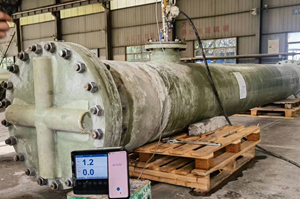
When it comes to on-site installation, FRP winding pipes primarily adopt two reliable connection methods: socket type with O-ring seals and flange type connections. The socket-and-O-ring design enables quick, tool-free assembly, with the elastic O-ring creating a tight, leak-proof seal that adapts to minor thermal expansions and contractions. Flange connections, on the other hand, are ideal for large-diameter pipes or applications requiring frequent disassembly for maintenance, providing a rigid, pressure-resistant joint secured by bolts. Both connection methods are engineered to maintain the pipe system’s integrity, but their performance—and the overall quality of the FRP pipe—can only be fully verified through a hydrostatic pressure test (hydrotest). This test is widely regarded as the most critical quality inspection procedure in the entire FRP pipe production process.

The standard hydrotest protocol for FRP winding pipes adheres to strict industry specifications, with the following step-by-step requirements:
1. Pressure Application: After the pipe and its connections are fully assembled, clean water is pumped into the pipe system until it is completely filled, with all air pockets removed to avoid false pressure readings. The water is then pressurized to 1.5 times the pipe's rated working pressure-a threshold set to simulate extreme operating conditions and validate the pipe's pressure-bearing capacity.
2. Pressure Holding & Observation: Once the test pressure is reached, the pressure source is disconnected, and the system is held under this pressure for a minimum of 2 minutes. During this period, inspectors carefully monitor the entire pipe length, connections, and seals for visible leaks, deformation, or abnormal sounds.
3. Pressure Drop Criterion: The test is deemed successful if the pressure drop during the 2-minute holding period does not exceed 5% of the initial test pressure. A pressure drop within this range confirms that the FRP pipe's winding structure is uniform and defect-free, and that the O-ring socket or flange connections are tightly sealed, with no water seepage or structural failure.
Only FRP winding pipes that pass this rigorous hydrotest are approved for delivery and installation, ensuring that they can operate safely and reliably in cooling tower water distribution systems for decades.